

The European Union Foreign Affairs Spouses, Partners, and Families Association (EUFASA AISBL) works to increase understanding of the many unique challenges that foreign service families face, and advocates for effective family support practices within European MFAs.
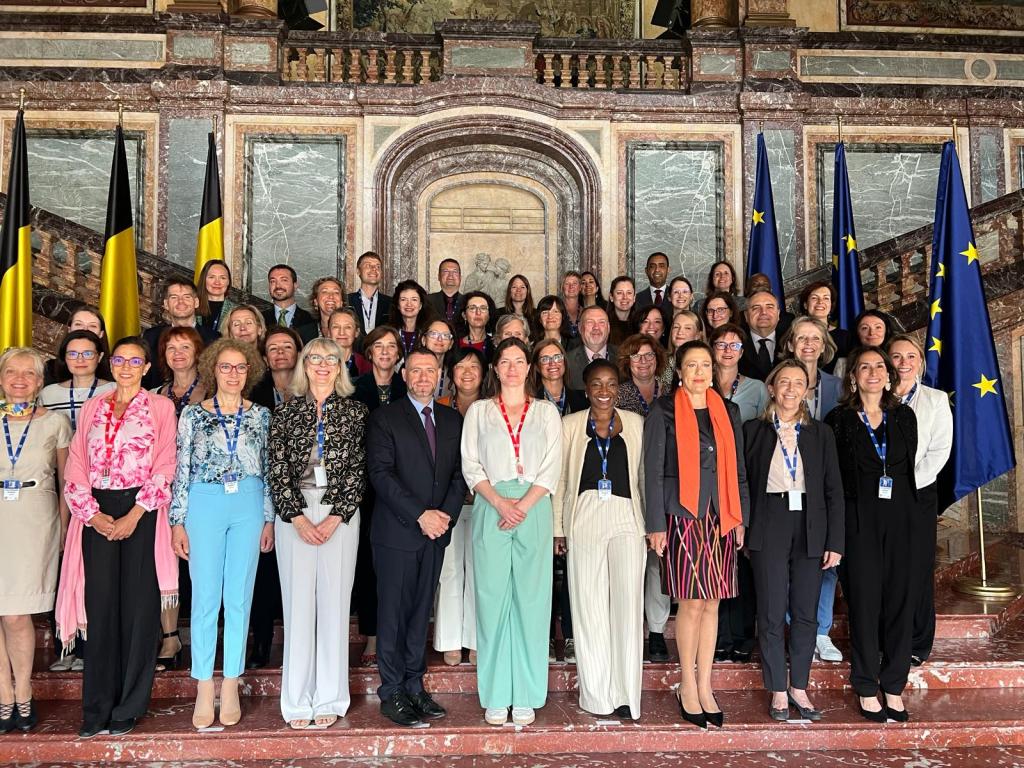
Delegates from 18 European foreign service family associations, as well as 11 Family Officers from around Europe attended the 40th annual conference, which took place in Brussels on 13-14 May 2024. Portugal was represented by Manuela Caramujo, President of the AFDP and Veronika Arsénio, EUFASA Delegate for Portugal, with the substantial contribution of Timea Pal to the Working Group on the UN Agenda 2030.
Belgium’s Foreign Minister Hadja Lahbib opened the conference, telling those in attendance that “the role of family policy within the Ministry of Foreign Affairs has never been more pivotal. Our diplomats traverse the globe, often relocating with their loved ones, to uphold our nation’s interests and values. It is our duty to ensure that their families are supported, their sacrifices acknowledged, and their well-being prioritized.”
The Main Topics addressed during the Conference were:
Paid employment: The latest report from the EUFASA Research Department (ERD) highlights the challenges faced by partners and spouses of foreign service officers in maintaining pensionable income. Despite high average educational attainment and their strong desire to work, diplomatic partners encounter multiple and significant barriers, such as work rights restrictions, unclear taxation and reduced competitiveness in the labour market, both in the home country and on posting. The full report is available here.
To better understand the level of un- and underemployment among foreign service partners, the ERD presented their plan to conduct a study of unemployment rates among foreign service partners and spouses, using OECD definitions and metrics which would be broadly comparable with country-level data. The AFDP will contact you to participate in this study which will be launched this fall.
Cross-border remote work: Research has found that a large majority of foreign service spouses and partners wish to work, also while posted abroad, for both the sense of purpose it gives them as well as their own financial security. Since the pandemic, interest in remote work options has grown significantly, but legal frameworks and information about how to work remotely have not kept pace with needs. EUFASA’s working group on Work and Employment therefore developed a guidance document for foreign service partners and spouses on remote work, which was presented at the conference. However, there continues to be a need for more information and clarity from MFAs about what is required to legally work remotely across international borders.
For more information on this topic, please read the Guidance document prepared by the EUFASA Work and Employment Group.
Divorce and Separation: The interviewing partners and spouses who had gotten divorced or separated made it very clear how difficult it is to remain financially independent when accompanying a foreign service officer on multiple posts abroad. This is not an issue that only affects those who divorce; it affects all foreign service partners and spouses. The result of the inconsistent ability to work, reduced ability to contribute to savings and pensions, etc. is that, when something happens to the relationship, the partner/spouse is likely to have considerably fewer financial resources to hire a lawyer, to rent or buy a home, and to re-establish him- or herself. Additionally, the unique legal situation we are in makes it more difficult for us to find a lawyer who will represent us, to leave post with our children if the spouse does not want us to, and to get custody of our children when we are posted abroad, among other challenges.
The attached report provides the EUFASA findings on these and other issues, as well as an extensive catalogue of possible approaches for both MFAs and associations to make improvements.
Children and multi-linguism: The children of foreign service employees adapt to regular and significant changes in their schooling and languages of instruction. The working group on children, chaired by Portugal, showed that these experiences are very individual, and highlighted the importance of having access to language support in the home language to help children to successfully transition back to their home country and school system.
EUFASA and the UN Agenda 2030: There is much that spouses and families of diplomats can do to support the UN Sustainable Development Goals. This year the Working Group dedicated to sustainability, which includes Portugal, presented the social and environmental impact of the textile and fashion industry, sharing practical tips on how to dress best by adopting sustainable and responsible attitudes. The AFDP plans to organize a specific webinar event on this topic in November 2024.
EUFASA New Members: EUFASA currently brings together 21 associations of foreign affairs spouses/families. It seeks to keep growing by supporting the creation of new associations in those European countries that do not have an association yet. A dedicated EUFASA Working Group, which includes Portugal, provides support to those who wish to form a new association. If you know spouses of diplomats from Croatia, Poland, Romania, Bulgaria, Denmark, Malta or Greece, please let them know that they can find support and inspiration from the AFSP and within the EUFASA community.
 AFDP
AFDP 
Deverá estar ligado para publicar um comentário.